With the need for renewable energy sources at an all-time high, Saildrone’s low-carbon ocean drones can help make new offshore wind farms a reality.
Ocean Drones with Zero Operational Carbon Footprint Helping to Mitigate Climate Change
Ocean Research
Published on
August 25, 2021
Location
Richmond, VA
Read time:
5
Minutes
Accelerating access to renewable energy sources is a critical element of mitigating the crisis of climate change. Saildrone’s environmentally friendly approach to enabling that acceleration is welcome news for wind farm developers around the world. Today Saildrone Inc. unveiled its Offshore Wind Life Cycle solutions at IPF, the premier Offshore Wind Conference held in Richmond, Virginia.
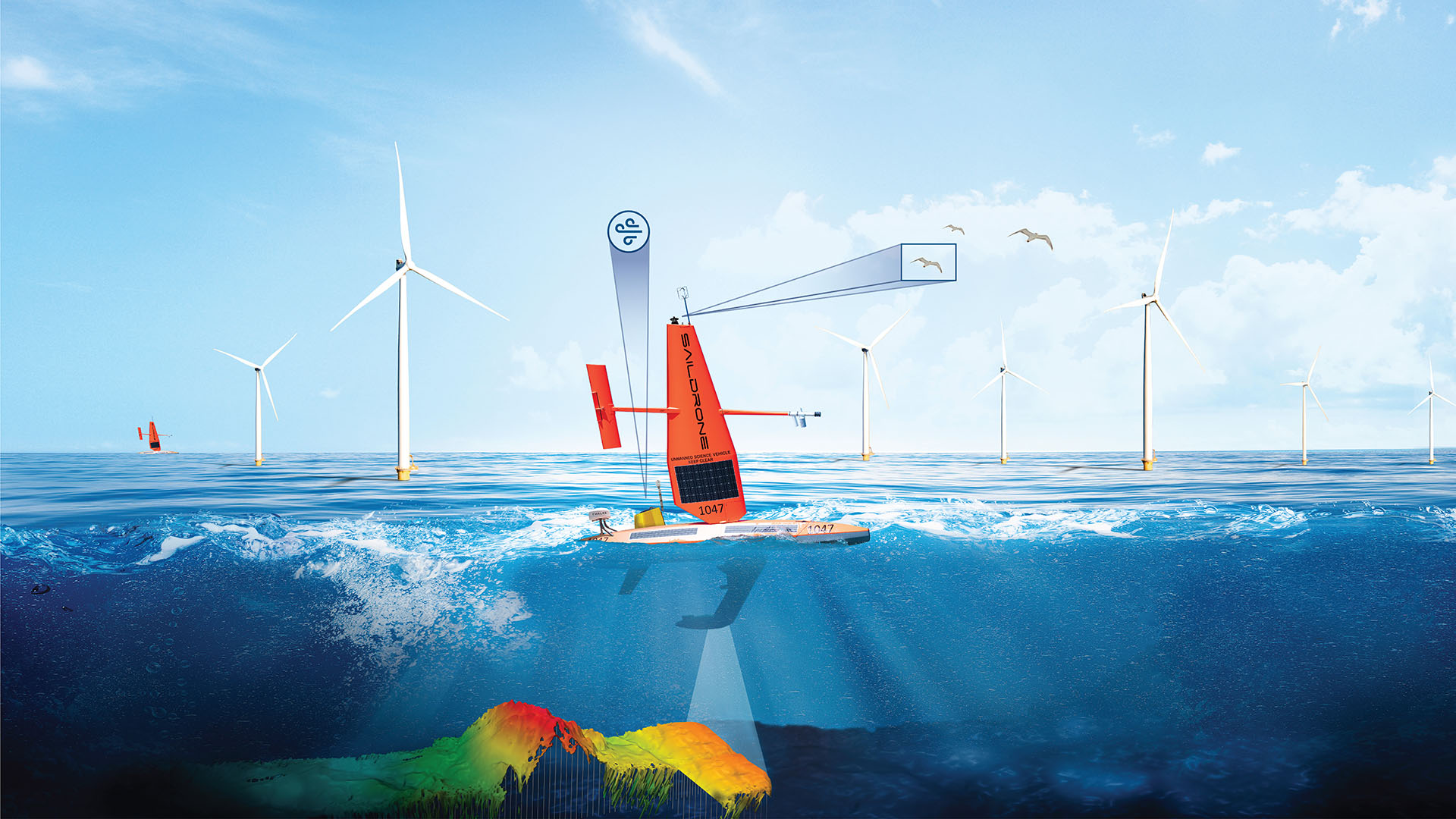
Showcasing the 23-foot Saildrone Explorer, Saildrone demonstrated how its uncrewed surface vehicles (USVs)—carrying state-of-the-art scientific sensors—can collect the ocean data that is critical for the planning, development, and operation of wind farms faster and at a fraction of the cost than traditional methods.
Saildrone uncrewed vehicles collect the in-situ data wind farms need in real-time—comprehensive metocean data such as wind monitoring, high-resolution ocean mapping, persistent maritime security, and even year-round ecosystem monitoring, ensuring there is no adverse impact to the surrounding marine environment.
With three vehicle classes ranging from the Explorer to the 72-foot Surveyor, Saildrone USVs are powered by renewable wind and solar energy with a minimal or zero operational carbon footprint. Without crew on board, saildrones can stay on mission from six to 12 months at a time, operating 24/7, gathering information more efficiently than by traditional manned ships, which are hard to schedule, expensive to hire, and limited to far shorter operational windows, counted in weeks rather than months.
Saildrone also provides critical infrastructure security. Saildrone’s passive acoustics, optical cameras, and advanced machine learning (ML) algorithms deliver real-time detection of anything in the vicinity of offshore wind farms—including commercial and recreational boats or other vessels that may have nefarious intentions and choose not to transmit their position. Saildrone’s ML system can also identify natural visitors like whales, seabirds, and bats to monitor environmental impact mitigation strategies.
The impressive capabilities of Saildrone’s autonomous vehicles have been proven in numerous missions for science, ocean mapping, and maritime security, covering over 500,000 nautical miles from the Arctic to the Antarctic. The Saildrone fleet has logged more than 13,000 days at sea in some of the most extreme weather conditions on the planet.
Contact Us
Jenn Virskus
Director Marketing, Saildrone
Office: (510) 956-8361
jenn.virskus@saildrone.com
About Saildrone
Saildrone designs, builds, and operates commercially developed unmanned surface vehicles for civil, commercial, and government missions. Built to perform in the world’s harshest environments, Saildrone platforms combine AI, advanced sensors, secure communications, and exceptional endurance to deliver persistent, wide-area maritime intelligence and seafloor insight. A modular architecture supports customer- and partner-furnished sensors and mission payloads, enabling multi-domain impact—from power projection and persistent ISR to real-time threat detection and tracking—while reducing cost, risk, and the burden on crewed assets. With proven operational success across the world’s oceans, Saildrone is advancing autonomous maritime operations to give decision-makers and warfighters the enduring advantage they need to act faster and operate farther.