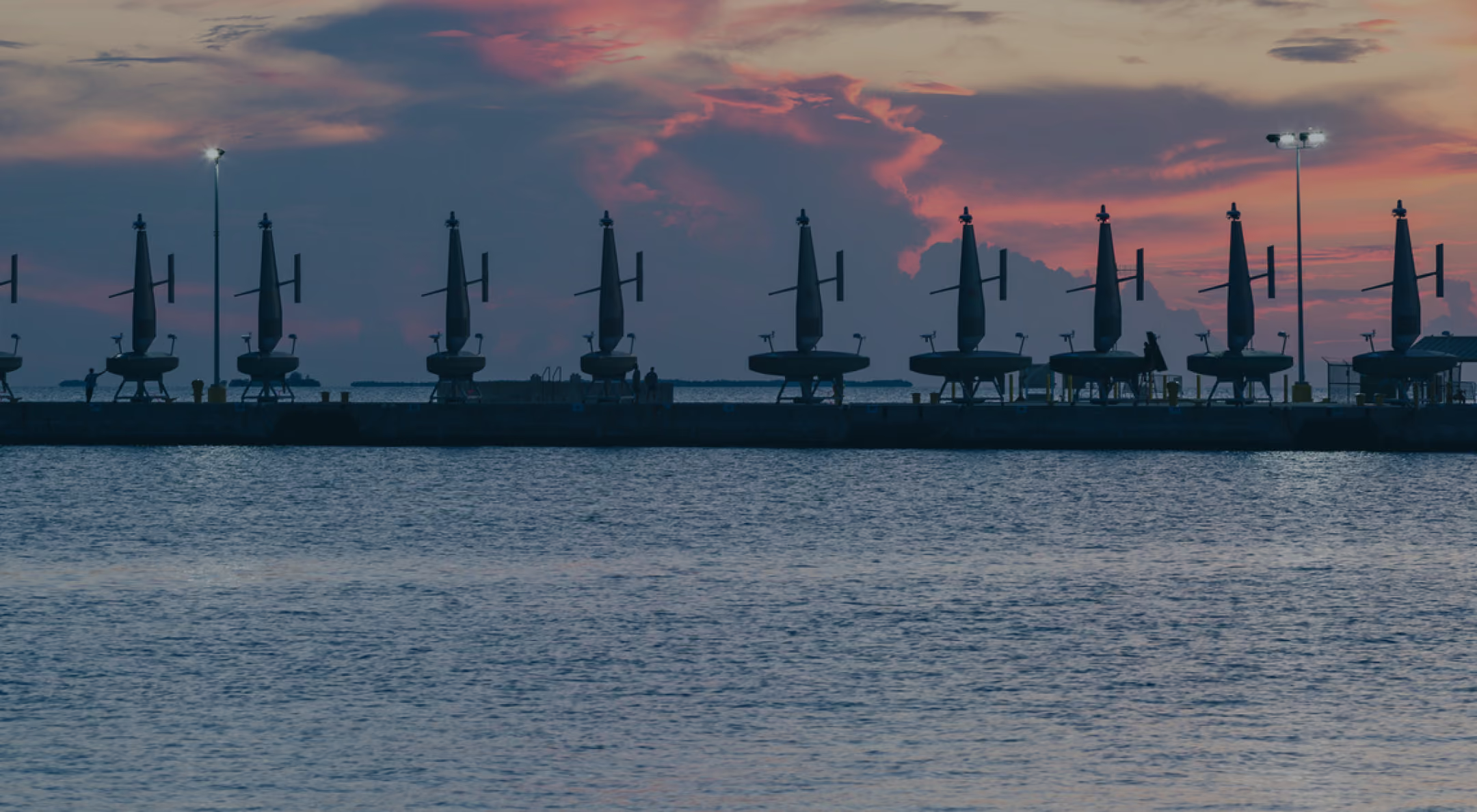
Saildrone’s largest, fastest, and most capable platform to date, Spectre, is designed to fill a critical ASW capability gap and deliver high-speed and stealth kinetic strike.
Introducing Saildrone Spectre: Next-generation USV for Anti-submarine Warfare and VLS Strike

Two Saildrone Spectre variants are built around different mission needs: Spectre Silent Endurance uses wing assist for extreme endurance and silent propulsion. Spectre Stealth meets all mUSV requirements.
Published on
April 20, 2026
Read time:
5
Minutes
The US Navy is facing unprecedented challenges in maintaining maritime superiority across numerous regional hotspots simultaneously. As global conflicts escalate, the service must contend with adversaries increasingly targeting strategically crucial waterways and critical undersea infrastructure. Furthermore, protecting these vast waters requires a continuous presence, which episodic patrols by traditional manned warships and capital assets cannot sustain.
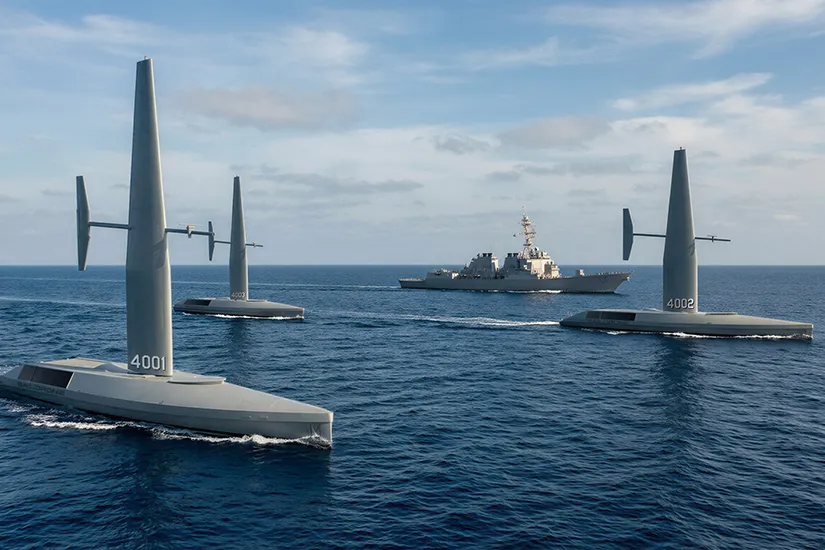
To close these coverage gaps cost-effectively, navies are turning to unmanned surface vehicles (USVs). Long-range, autonomous platforms provide the enduring presence necessary to safeguard these theaters and can be equipped with the mission-oriented payload effects that commanders require to respond to threats. USVs shoulder the burden of maintaining persistent maritime presence, allowing navies to deploy their most valuable crewed assets exclusively for the complex missions only they can perform.
Saildrone, the world leader and most experienced operator of unmanned surface vehicles, is today announcing its newest platform, Spectre. At 52 meters (170 feet) long, weighing 250 tonnes, and capable of up to 30 knots, Spectre is a high-endurance USV designed to deliver multi-mission effects above and below the surface. Spectre’s design is engineered from the keel up for long-range, quiet, persistent operations and leverages more than 10 years of Saildrone’s experience operating USVs in the world’s harshest environments.
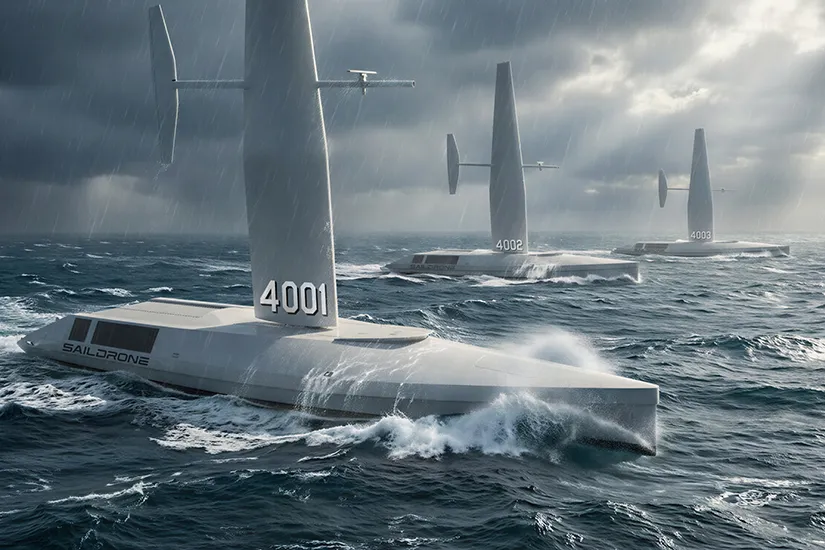
“Spectre is the result of 25 years of continually pushing the boundaries of what’s possible. A unique design evolved through the hard lessons of operational experience in the real world,” said Richard Jenkins, Saildrone’s founder and CEO. “Spectre is not a craft hurriedly readied to meet a particular RFP, but diligently evolved over multiple years to meet the operational requirements of our customers and fill critical capability gaps in the ASW domain.”
Saildrone is the first, and only, company to achieve American Bureau of Shipping (ABS) class certification for its USVs. ABS has already granted Approval in Principle (AIP) for Spectre, which complies with High Speed Naval Craft certification. Classification societies like ABS define the standards that ensure vessels are safe to operate and built to withstand the ocean’s harshest conditions. This certification requires passing a comprehensive review of Spectre’s design, construction, and operations. The autonomy software that controls Spectre has been honed throughout Saildrone’s more than a decade of operations at sea and is fully capable of complying with COLREGS in both day and night conditions.
Unmatched endurance and mission modularity
Like the Saildrone Voyager and Surveyor, Spectre leverages wind, solar, and diesel propulsion, but Spectre is no ordinary diesel ship. Spectre runs twin shaftlines with dual electric and diesel propulsion, enabling near-silent electric propulsion up to 12 knots, before kicking in 5,000 horsepower of Caterpillar diesel engines to propel the vessel up to 27 knots with full fuel and a 25-ton payload. Cruising at 25 knots with a 25-ton payload, Spectre has a range of 3,280 nautical miles in flat water and 2,790 nm range in Sea State 4. Controllable-pitch propellers enable extremely efficient operations throughout the speed range, allowing for controllable acoustic signatures and near-silent slow-speed operations for tow bodies such as thin-line towed arrays and variable-depth sonar systems.
The concealed payload deck provides room for containerized payloads, ranging from dual 40-foot containers, up to five 20-foot containers, or a mixture of configurations in between. This unique configuration, close to the waterline, allows easy deployment of payloads via the transom, while the bulwarks protect them from prying eyes and the relentless driving sea spray that will be relentless at high speeds in rough weather. Spectre’s maximum payload capacity is over 70 tonnes.
Spectre has two variants depending on customer requirements:
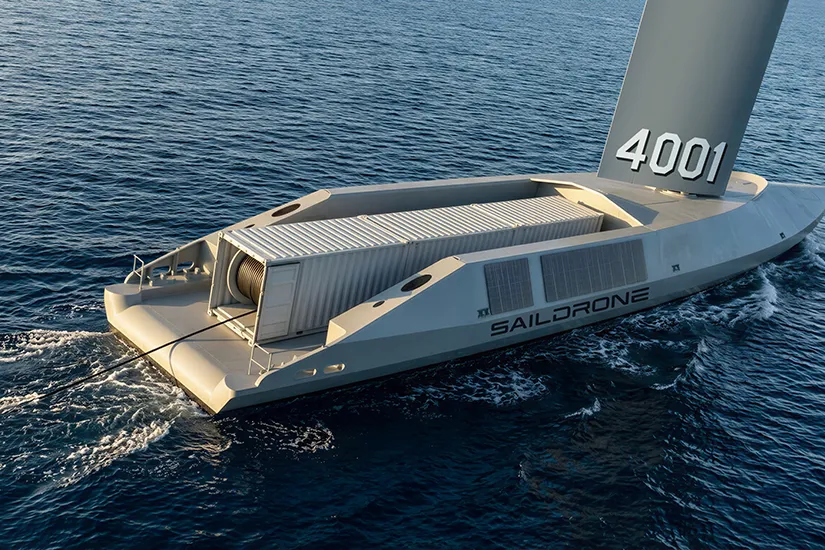
Spectre Silent Endurance features the Saildrone Wing, which offers added range, endurance, sensor height, and get-home capability for missions of more than 8,000 nautical miles. Its hybrid propulsion, which enables nearly silent transits at up to 12 knots, is optimized for ASW and other acoustically sensitive mission sets.
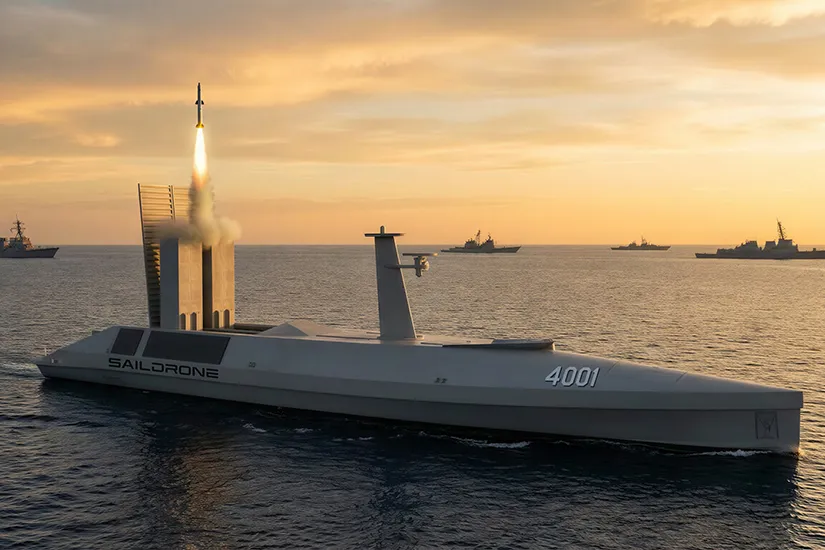
Spectre Stealth, leveraging a wingless configuration, maximizes speed and minimizes visual and radar signature. Its lower profile is ideal for operations where speed, visibility, and signature impact mission performance. From the outset, Spectre was designed to operate without the wing for kinetic strike roles, which require higher sprint speeds and low-profile stealth operations.
Spectre performance is not just theoretical; it has been verified and tested at Force Technologies’ tow tank in Copenhagen, Denmark. Many months of testing and evolution on a 1/7th-scale model verified propulsive power requirements and seakeeping in conditions up to full speed in Sea State 5. Only through diligent physical tank tests can CFD results be verified and propulsion systems be optimized to deliver guaranteed performance at full scale.
Spectre will support containerized payload integration to accelerate deployment and integration into the modern fleet seamlessly across theaters, providing a world-class suite for undersea sensing and response. The USV will accommodate flexible payload configurations, ranging from two 40-foot containers, up to five 20-foot containers, and a mixture of configurations in between.
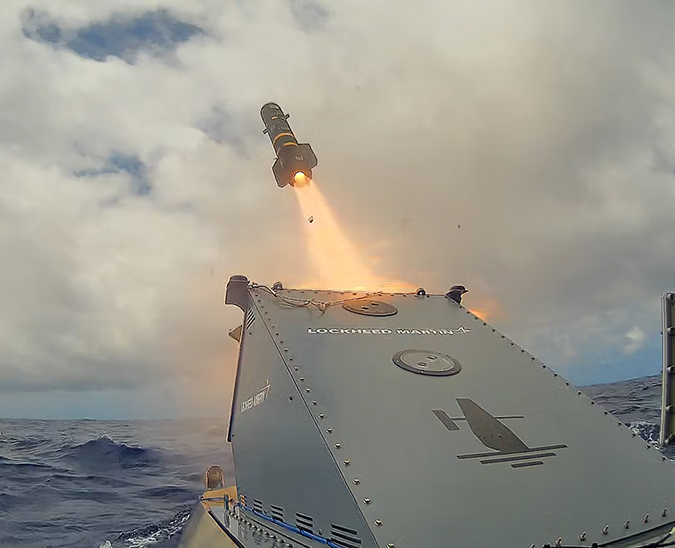
Transcending traditional intelligence, surveillance, and reconnaissance (ISR) roles, Spectre is built to carry the types of mission-tailored effects commanders need. To deliver these capabilities, Saildrone and Lockheed Martin will integrate numerous payloads as part of a $50 million strategic partnership signed in October 2025. These include the Mk70 VLS launcher, active and passive ASW arrays such as the TB29 thin-lined towed array, and electronic warfare systems.
Many months of testing and evolution on a 1/7th-scale model of Spectre verified propulsive power requirements and seakeeping in conditions up to full speed in Sea State 5.
“Spectre represents a transformative step forward for naval surface warfare. Its endurance, payload flexibility, and seamless integration with advanced missile and sonar systems will give the US Navy a persistent, low observable USV that can deliver on a spectrum of maritime missions,” said Paul Lemmo, vice president and general manager, sensors, effectors, and mission systems at Lockheed Martin. “Lockheed Martin is proud to partner with Saildrone to bring this capability to life, and we look forward to demonstrating its power at upcoming on-water, live fire demonstrations.”
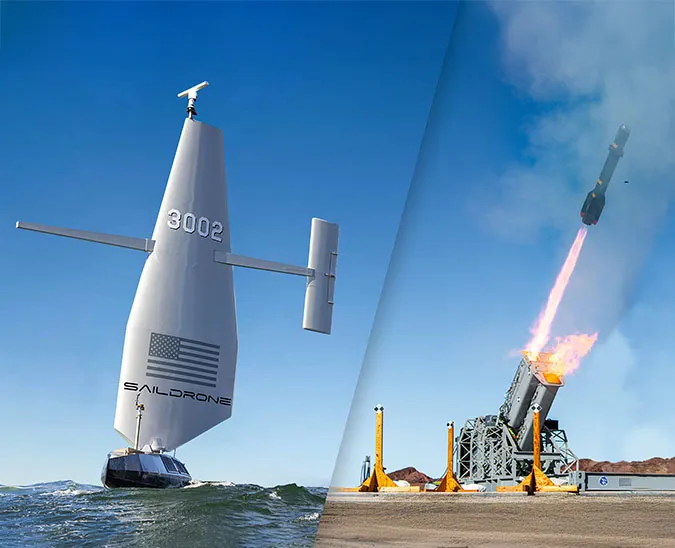
Lockheed Martin is currently working with Saildrone to integrate a JAGM missile launcher onto a Saildrone Surveyor. A live-fire demonstration against a high-speed, maneuvering surface target, scheduled for this summer during the US Navy’s Rim of the Pacific (RIMPAC) exercise, will directly support Spectre’s development by de-risking the integration between a Saildrone platform and Lockheed Martin’s payloads.
Saildrone is also working with Thales to integrate the Combined Active Passive Towed Array Sonar-4 (CAPTAS) Variable Depth Sonar on Spectre. This project expands on previous Office of Naval Research-funded work, integrating Thales Australia’s BlueSentry array on the Saildrone Surveyor.
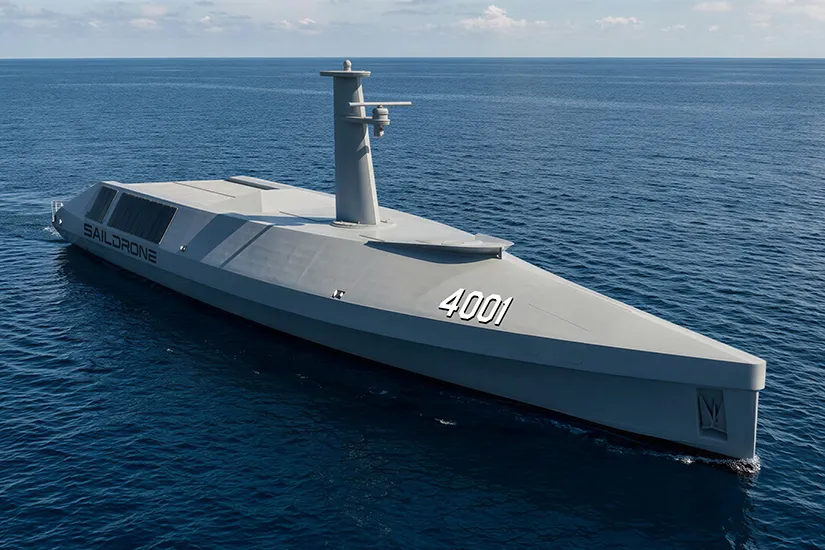
Fincantieri Marinette Marine will build the aluminum hull form for both variants of Saildrone Spectre at its Wisconsin system of shipyards, which has the capacity to build five Spectre vessels per year. A staple shipyard for the US Navy, Fincantieri’s experience and established workforce make it an ideal partner to meet customer demand for Saildrone’s newest platform. Construction will begin shortly, with the first vessel undergoing sea trials in early 2027.
“Saildrone’s decades of operating unmanned surface vessels, combined with Spectre’s unique features as a multi-mission platform, represent an ideal case on which to apply Fincantieri Marine Group’s proven expertise in the serial production of aluminum vessels. We are excited to join this formidable team and swiftly deliver these capabilities to the warfighter,” said Fincantieri Marine Group CEO George Moutafis.
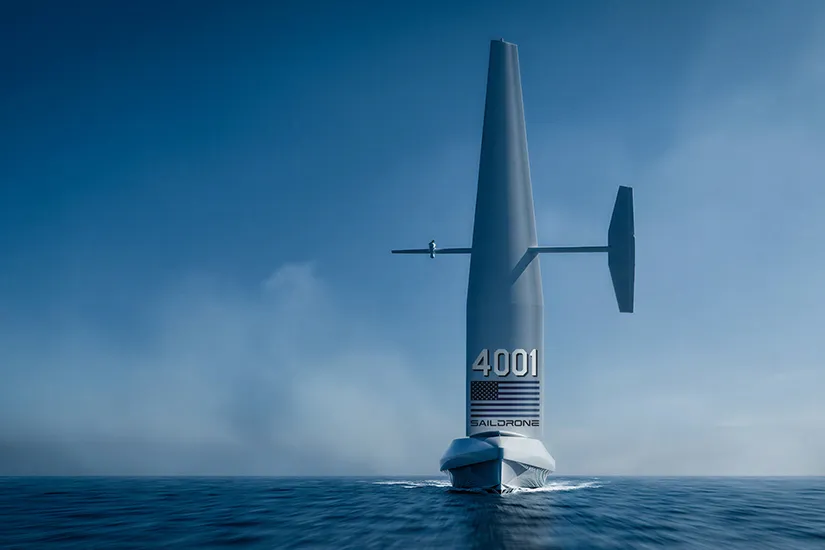
The 43-meter (140-foot) composite Saildrone Wing will be manufactured by American Magic Services (AMS) at the American Magic High Performance Center in Pensacola, FL. Drawing on a pedigree in high-performance America’s Cup racing, AMS brings advanced composite engineering and manufacturing capabilities to the platform. Building on its experience serving the marine, aerospace, and defense industries, AMS is capable of producing five Spectre wings per year.
“Saildrone has set the standard for innovation and performance in unmanned systems, and we’re proud to support the advancement of the Spectre platform,” said American Magic Services CEO Tyson Lamond. “At the American Magic High Performance Center in Pensacola, in close proximity to key US naval and maritime operations, we bring together elite composite manufacturing and a proven high-performance culture, positioning us to deliver at the level this platform demands.”
A new chapter in autonomous maritime capability
To maintain a decisive edge in increasingly contested waters, the US Navy requires platforms capable of both near-real-time ISR and mission-specific effects. Spectre answers this demand by delivering a high-endurance, autonomous USV derived from Saildrone’s legacy of unmanned operations and built specifically for maritime power projection.
By integrating combat-proven payloads to deliver rapid kinetic and electronic warfare effects, Spectre provides fleet commanders with a decisive advantage to shape the battlespace. Ultimately, Spectre gives commanders a persistent, mission-ready capability tailored to the realities of modern maritime competition.
Spectre is the next step in Saildrone’s vision for autonomous naval power: not as a future concept, but as an operational capability designed to extend reach, sharpen awareness, and help secure the seas where persistence matters most.
Must Read

[
NEVER MISS AN UPDATE
]
Stay informed with the latest research findings and updates.
By clicking Sign Up you're confirming that you agree with our Privacy Policy.