As Arctic sea lanes become more navigable and subsurface activity increases across the High North, naval forces need persistent, scalable ASW capabilities. Saildrone Spectre is designed to extend autonomous surveillance across strategic chokepoints where endurance matters most.
Autonomous USVs Can Help Secure the GIUK Gap

Published on
May 12, 2026
Read time:
5
Minutes
The Greenland-Iceland-United Kingdom (GIUK) Gap is a high-stakes maritime gateway. Melting polar ice is transforming once-impassable regions like the Northwest Passage into viable corridors for global trade. While these routes offer economic potential, they also provide a newly navigable back door for adversarial submarines to transit undetected from the Arctic into the deep Atlantic. These changes necessitate a new layer of uninterrupted monitoring across this evolving strategic chokepoint.
The GIUK Gap is not a singular point of entry but a fragmented 700 nautical mile corridor divided into two distinct passages: the 200 nm Denmark Strait between Greenland and Iceland, and the 500 nm span stretching toward the United Kingdom. This split increases operational complexity, as naval forces must coordinate surveillance across both gateways simultaneously to detect, track, and deter adversarial submarines. The sheer scale of this geography—and the requirement for persistence—creates a complex area of responsibility that strains the capacity of manned fleets. Monitoring a maritime chokepoint of this scale with manned ships presents myriad financial, logistical, and manpower challenges, as maintaining a continuous presence across such an expansive and volatile geography requires a level of endurance that is impractical for crewed fleets. The current approach to anti-submarine warfare (ASW) is unsustainable.
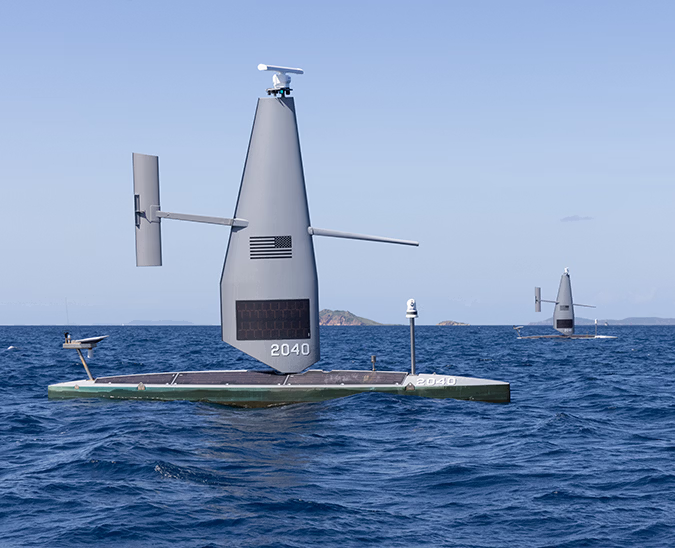
Securing these waters depends on achieving persistent maritime domain awareness across the GIUK Gap and the broader regions of the High North and Mid-Atlantic. Saildrone Spectre offers an enduring capability that complements crewed fleets and fixed ocean-floor sensors. Operating autonomously, the platform maintains a continuous watch on and below the surface to create an uninterrupted layer of awareness. By providing persistent, wide-area coverage, Spectre serves as a force multiplier, enhancing the fleet’s overall reach.
A 21st-century anti-submarine warfare solution
Saildrone Spectre’s hybrid propulsion architecture makes it an optimal platform for ASW. Spectre leverages wind, solar, and diesel propulsion, running twin shaftlines with dual electric and diesel propulsion, enabling near-silent electric propulsion up to 12 knots—ideal for towing active and passive sonar systems.
As Saildrone’s largest platform at 52 meters (170 feet) in length, Spectre can motor at 27 knots for 2,700 nm with full fuel in Sea State 4, as well as accommodate containerized payloads, ranging from dual 40-foot containers, up to five 20-foot containers, or a mixture of configurations in between.
The platform offers two variants depending on customer requirements. Spectre Silent Endurance utilizes the Saildrone Wing and the platform’s hybrid propulsion for added range, endurance, and sensor height. Spectre Stealth leverages a wingless configuration to maximize speed and minimize its visual and radar signature.
Security in the High North now hinges on the ability to maintain enduring intelligence, surveillance, and reconnaissance that remains impractical and cost-prohibitive for manned fleets. By filling the surveillance gap with autonomous platforms, naval forces can maintain oversight of critical maritime chokepoints such as the GIUK Gap, while freeing manned assets to tackle more critical missions.
The Saildrone Spectre represents a move from reactive patrolling to proactive defense. Through industrial partnerships, Saildrone is delivering a mission-ready solution, backed by 12+ years of proven operational experience at sea.
Saildrone delivers an enduring capability tailored to the realities of modern maritime competition. The company’s vision for autonomous naval power extends fleet reach, sharpens awareness, and helps secure critical corridors like the GIUK Gap, where persistence matters most.


[
NEVER MISS AN UPDATE
]
Stay informed with the latest research findings and updates.
By clicking Sign Up you're confirming that you agree with our Privacy Policy.