Court orders Navy to reevaluate Saildrone’s proposal for the Medium Unmanned Surface Vessel program.
Saildrone Wins MUSV Protest in the US Court of Federal Claims

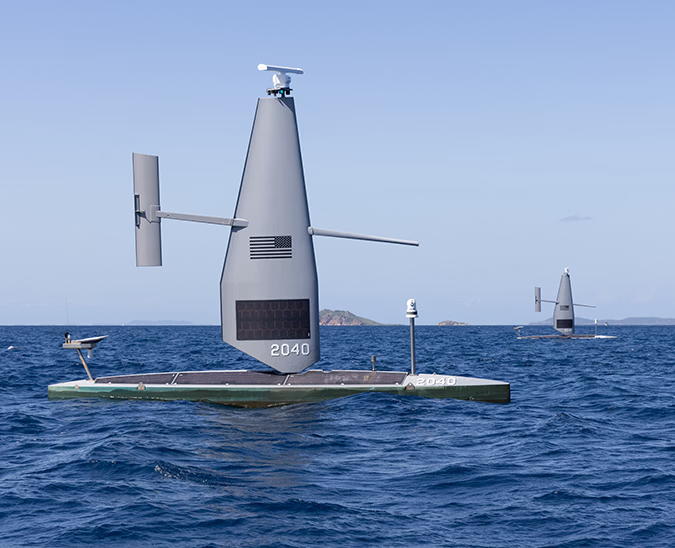
Renderings of Saildrone Spectre in Stealth Strike configuration (left), without a wing for high-speed operations, and Silent Endurance configuration (right), with a wing for extended missions at sea.
Published on
November 2, 2026
Read time:
5
Minutes
Saildrone is gratified by Judge Hadji’s ruling at the US Court of Federal Claims setting aside the Navy’s decision to unfairly eliminate Saildrone from the Medium Unmanned Surface Vessel (MUSV) competition.
The Court determined that Saildrone was unlawfully excluded and ordered the Navy to promptly reevaluate Saildrone’s proposal using the same criteria it applied to other competitors. Until it does, the Navy cannot commit more than $1.5 billion of the program’s $2.1 billion to production.
Saildrone brought its challenge to the Court of Federal Claims because its proposal met or exceeded every requirement in the Navy’s Medium Unmanned Surface Vehicle (mUSV) solicitation, yet Saildrone was excluded from competition after being falsely deemed non-compliant by the Navy across all three evaluation criteria. When challenged by Saildrone, the Navy promptly abandoned two of its determinations of non-compliance, and the Court has now rejected the sole remaining determination, finding that the Navy applied arbitrary and capricious criteria to Saildrone that were not applied elsewhere in the competition.
“Saildrone has spent over a decade proving itself at sea, pioneering unmanned maritime intelligence in some of the harshest ocean environments and hostile operational combat situations,” said Richard Jenkins, Saildrone’s founder and CEO. “The future of naval warfare will be fought on the water, not in a courtroom. We are eager to move beyond this litigation and return our entire focus to delivering world-leading maritime autonomy for the US Navy, to help secure America’s future maritime dominance. This ruling is a win for fair competition, for taxpayers, and for national security.”


[
NEVER MISS AN UPDATE
]
Stay informed with the latest research findings and updates.
By clicking Sign Up you're confirming that you agree with our Privacy Policy.