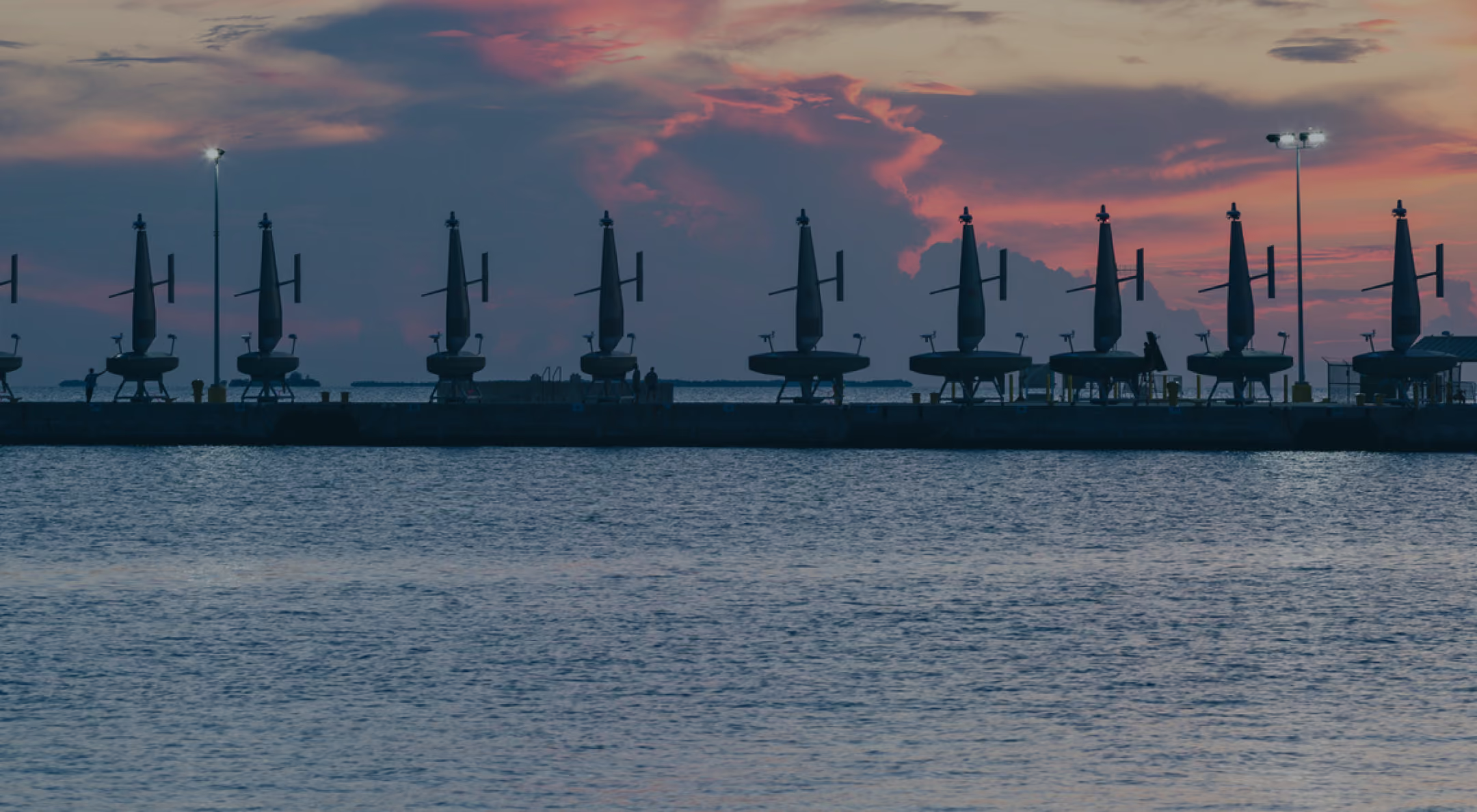
In partnership with NOAA, 10 Saildrone USVs will gather near-real-time data from inside extreme storms to improve rapid intensification forecasting and protect coastal communities.
Saildrone Fleet to Intercept Hurricanes for Fifth Season

Image captured by Saildrone Explorer SD-1083, close to the eyewall of Hurricane Helene on Sept. 26, 2024, in wind gusts up to 84.63 knots and waves up to 16 m (52 feet).
Published on
May 21, 2026
Read time:
5
Minutes
Major hurricanes can destroy residential homes, inflict severe economic damage on local businesses, and even force unplanned movements for the military. The danger posed by a tropical cyclone is exceptionally severe when a storm undergoes rapid intensification, defined as an increase in maximum sustained wind speeds of at least 30 knots (35 mph) in 24 hours.
This process remains difficult for forecasters to predict, but the consequences can be dire. If a hurricane rapidly intensifies just before landfall, authorities have little time to prepare the public, thereby increasing the likelihood of severe damage to communities and loss of human life.
To support the National Oceanic and Atmospheric Administration’s (NOAA) efforts to better understand rapid intensification, this summer, Saildrone will deploy 10 Saildrone Explorer unmanned surface vehicles for the company’s fifth hurricane mission.
The mission continues a multi-year collaboration between NOAA and Saildrone that began in 2021. NOAA scientists will define the operational objectives and provide mission tasking as tropical storms develop; Saildrone will operate and navigate the USVs to deliver in situ oceanographic and meteorological data in real time.
This video shows some of the most extreme hurricane conditions Saildrone has experienced since 2021 while collecting data for NOAA. Notable hurricanes include Hurricane Sam, Hurricane Ian, Hurricane Idalia, Hurricane Helene, and Hurricane Milton.
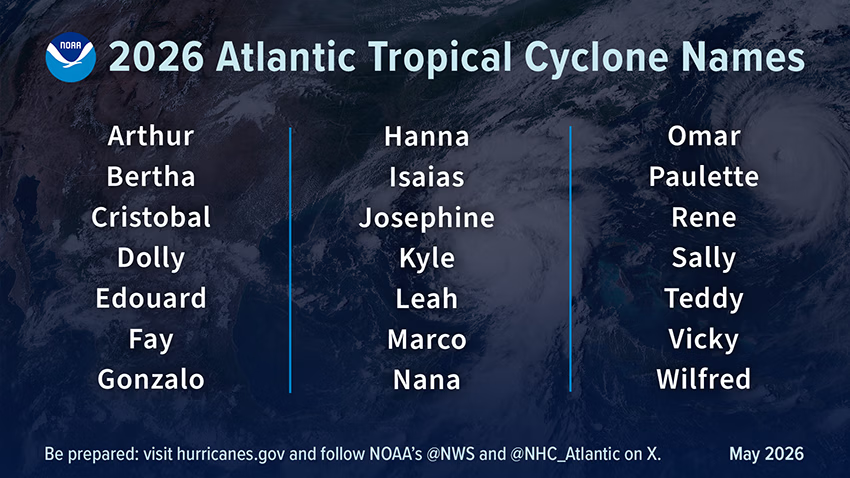
The Saildrone USVs will be strategically positioned in the western tropical/subtropical Atlantic Ocean, Caribbean Sea, and Gulf of America from August to November. As tropical cyclones develop, Saildrone mission operators will coordinate with NOAA to maneuver the USVs in and around the storms.
NOAA scientists at the Atlantic Oceanographic & Meteorological Laboratory (AOML) and the Pacific Marine Environmental Laboratory (PMEL) will use data to study how exchanges of heat, moisture, and momentum between the ocean and the atmosphere influence storm intensity.
“This multi-year mission between NOAA and Saildrone is helping to improve our understanding of how hurricanes intensify, including when they strengthen rapidly before landfall,” said Greg Foltz, an oceanographer at NOAA and one of the principal investigators on the mission. “Each storm we observe gives us more data to evaluate and improve prediction models, which is critical for increasing forecast confidence, extending warning lead times, and strengthening the nation’s preparedness for high-impact weather events.”
Each Saildrone Explorer will be equipped with a suite of meteorological and oceanographic (metocean) sensors to measure wind speed and direction, air, surface, and sub-surface temperature, relative humidity, barometric pressure, salinity, and wave height and period. Additionally, two USVs will carry NOAA ASVCO2 sensors to measure the exchange of carbon dioxide between the ocean and the atmosphere. These observations will support NOAA’s hurricane research and modeling efforts.
“The NOAA hurricane mission is one of Saildrone’s longest-running and most successful partnerships, and also one of the most technically demanding,” said Matt Womble, vice president of government relations at Saildrone. “This mission reinforces the value of mature, long-duration uncrewed systems for operating in environments where persistent data collection is otherwise impossible by traditional means. Better hurricane data supports better forecasts, and better forecasts strengthen national resilience—protecting lives, infrastructure, commerce, and critical operations. Saildrone is tremendously proud to continue this work with NOAA.”
Hurricanes pose a major threat to national and economic security, with impacts that can include loss of life, severe damage to homes and businesses, disruption to ports and supply chains, impacts to critical infrastructure, and interruptions to military and emergency-response operations. According to NOAA’s National Centers for Environmental Information (NCEI), between 1980 and 2004, tropical cyclones accounted for 52.9% of all billion-dollar disasters in the United States—more than wildfires, drought, flooding, freeze, severe storms, and winter storms combined. The estimated total damages (CPI-adjusted) from tropical cyclones over that time period exceed $1.5T.
Recent storms, including Hurricane Idalia in 2023, Hurricane Ian in 2022, and Hurricane Harvey in 2017, have rapidly intensified just before landfall, underscoring the need for better observations in the ocean regions where storms gain strength. NOAA aims to improve weather forecasting models, ensuring that state and local officials, and by extension the general public, receive longer lead times to prepare and evacuate accordingly.
Four years of intercepts and lessons learned
Saildrone has supported NOAA hurricane research across multiple seasons, deploying five USVs in 2021, seven in 2022, and 12 in both 2023 and 2024. Saildrone Explorers are multi-mission USVs, and several have been deployed on multiple hurricane missions; to date, 21 different USVs have been used in these missions. Since 2021, Saildrone has intercepted 21 named hurricanes and tropical storms on 46 occasions. In total, Explorer USVs have spent more than 2,600 days on mission supporting hurricane research. During each mission, Saildrone’s fleet has been co-located with NOAA’s aerial and sub-surface assets to form a comprehensive picture of the air and water column.
SD-1045, which set a Guinness World Record in 2021 for the highest wind speed measured by a USV, will deploy this year for its fourth hurricane mission. Data collected by SD-1045 during Hurricane Sam in 2021 indicated that surface salinity likely plays a role in the intensification process. Scientists believe that freshwater runoff from the Amazon River formed a barrier that prevented cooler, deeper water from mixing upward, allowing surface heat to continuously evaporate into energy and fueling the storm's intensification.
Saildrone’s efforts have also provided the only direct field observations of the ocean’s drag on hurricane winds, a phenomenon that is important to accurately represent in forecast models.
In 2024, Saildrone USVs intercepted hurricanes at different points around the eyewall. These were critical observations because the wind and ocean on different sides of the eye interact with the atmosphere differently. Specifically, on the right side of a storm, the winds and ocean waves move in the same direction, whereas on the left side, the winds and waves move in opposite directions. Scientists believe these complex dynamics regarding how the ocean and atmosphere exchange heat and momentum may also influence hurricane intensification.
An ideal USV for the job
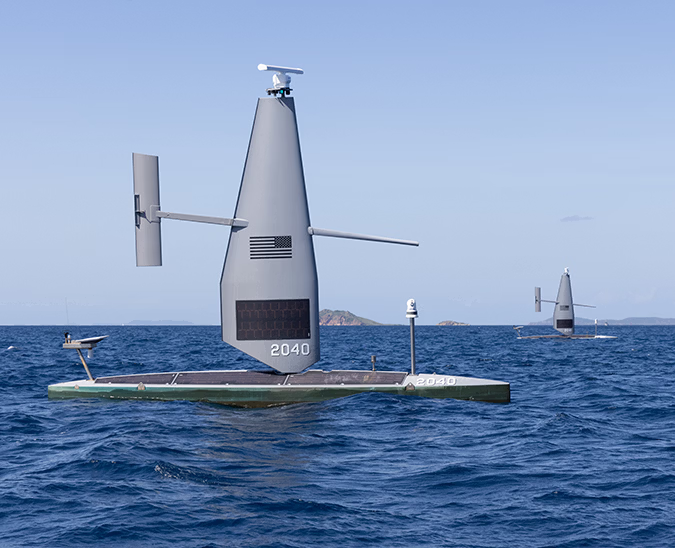
The Saildrone Explorer is a 7-meter (23-foot) USV designed to deliver continuous metocean observations across remote and extreme environments. The USVs used for the hurricane monitoring mission are equipped with a shorter, more robust “hurricane” wing, specially designed to withstand the conditions inside a tropical cyclone.
The USVs used for the hurricane monitoring mission have a shorter, more robust “hurricane” wing, specially designed to withstand the conditions inside a tropical cyclone. Functioning similarly to a reefed sail on a sailboat, Saildrone engineered this wing to survive winds over 110 mph and towering waves exceeding 50 feet. The Saildrone Explorers operate in conjunction with existing NOAA aerial and subsurface assets to provide a comprehensive view of the air and water column inside a hurricane.
For the 2026 hurricane mission, Saildrone will transmit data via satellite in near-real time directly to global forecast centers. This intelligence aids prediction models, empowering state and local officials to issue earlier, more accurate public warnings, reducing damage to residential homes and businesses, and preserving human life.
In addition to the hurricane mission, Saildrone will operate more than 75 USVs globally this year, supporting national and homeland security, ocean mapping, and research. By consistently operating in the most extreme weather conditions on Earth, Saildrone demonstrates the power of autonomous platforms to enhance national and economic security. This ongoing partnership represents a critical step in Saildrone's broader vision: delivering persistent, wide-area intelligence to protect human life and enhance national and economic security.
Resources
NOAA National Centers for Environmental Information (NCEI) US Billion-Dollar Weather and Climate Disasters (2025). https://www.ncei.noaa.gov/access/billions/, DOI: 10.25921/stkw-7w73


[
NEVER MISS AN UPDATE
]
Stay informed with the latest research findings and updates.
By clicking Sign Up you're confirming that you agree with our Privacy Policy.